Medias - 18 November 2026

AFGHANISTAN: THE LIBRARY AS A SPACE OF FREEDOM

On the 15th of August 2021, the Taliban regained power in Afghanistan. Since then, the horizons of Afghan women and girls have narrowed. In provinces where it intervenes, Libraries Without Borders continues to open spaces where reading, playing, growing, as well as resisting remains possible for children and young people alike. 

Women and Girls Reduced to Silence

Five years later, the war has ended, but another form of repression has taken hold, one that is more conspicuous and systemic, that of Afghan women and girls.

Since seizing power, the Taliban has issued more than a hundred decrees which have progressively stripped Afghan women’s right to study, work, travel unaccompanied, and participate in public life. Afghanistan has become the only country in the world to ban girls from attending school beyond the sixth grade. According to UNESCO around 2.4 millions among them are currently denied access to secondary education, a figure that could reach 4 million by 2030 if nothing changes. On top of that, only 7 percent of Afghan women are employed, compared to 84% of men, according to UN Women.

Behind these numbers, there are trajectories of peoples lives that have been brought to an abrupt halt. The United Nations estimates that the country may loose 25,000 female teachers and healthcare professionals by 2030 if these restrictions continue, a double blow for Afghan women who are already deprived of recieving care from other women. 


On the Ground, Spaces that Resist

In this context, continuing to offer access to education, culture, and information has become necessary. This is the essence of BSF’s commitment in Afghanistan, where we have been working since 2023, alongside CDDO and Acted, with the support of the European Union and the Center of Crisis and Support (CDCS).

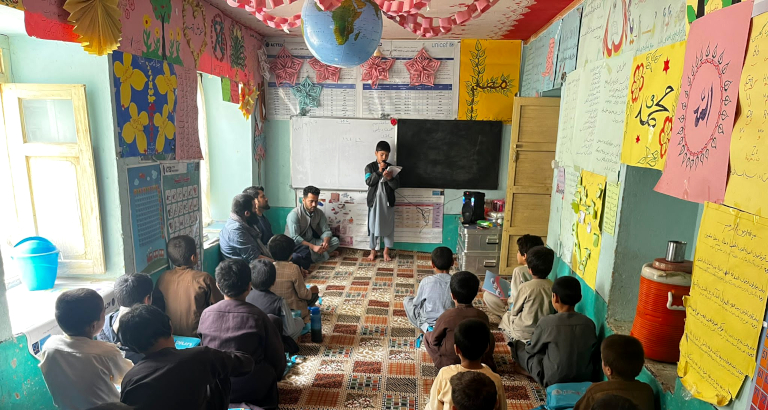
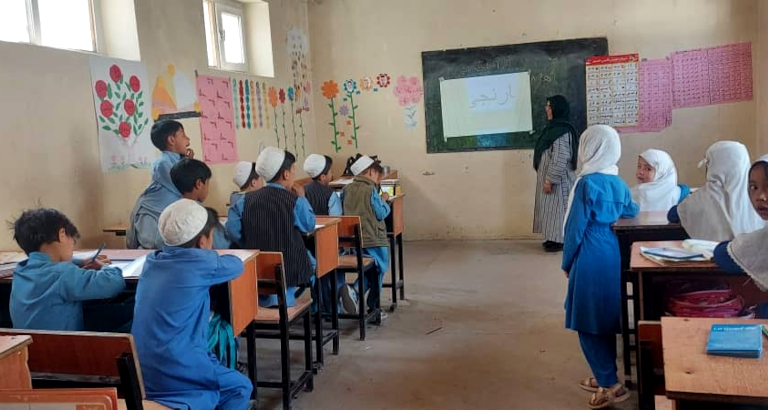
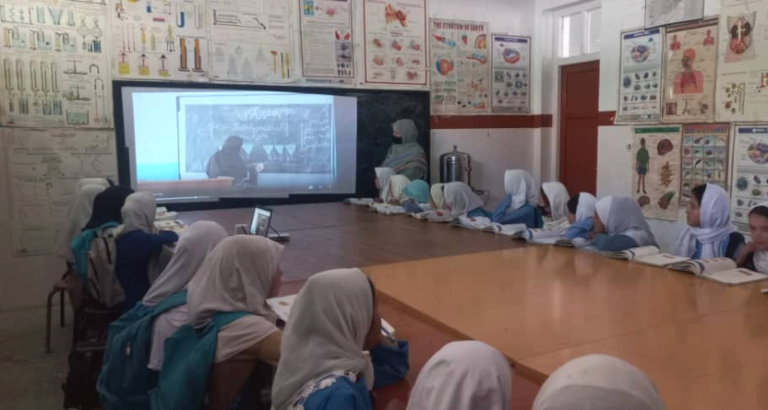
 We began our work in primary schools in Kabul and in Bamyan, with CDDO. Girls and boys there attend class from first to sixth grade. Our ideas cube, a standalone server that generates a local network to which tablettes and computers can connect to without internet, provides access to thousands of educational and cultural resources. “In the past, using digital tools in class was complicated: It required a stable connection and electricity. With the ideas cube, teachers and students can now access educational resources for hours on end”, explains Habibullah Hasheli, educational specialist at CDDO. Dari-language materials and math are the most usitilized resources. Amongst the youngest children, illustrated content for learning the alphabet generates the most excitement. Among teachers, modules regarding classroom managment and how to engage less participative students proved to be the most useful. 

 In partnership with Acted, we have worked in community spaces across the North and East of the country, specifically in Kunduz, Baghlah, Balkh and Takhar. These interventions fall outside of the scope of formal education. On one hand, they are children friendly spaces, where they can come to read, play, and feel a sense of security. On the other hand, these are centers for youth development that offer psychosocial support, and creative spaces for activities likes writing, creating radio shows, and video editing- where young people can share stories about their daily life. LWB has deployed microlibraries in these locations, stocked with books, games, and tablets with educational materials. “One child who initially showed very little interest in reading began choosing books on his own after a few storytelling workshops.” explains Azmuddin Rahimi, an emergency project coordinator at Acted. “ This reinforces our conviction: children learn better when they feel safe, interested, and fully involved in their own learning”, he adds.


These spaces are largely visited by children outside of the school system, explains Laila P, who is the head project manager at LWB in Afghanistan. “ Most of them are children who are outside of the school system, or who are forced to work in the street to support their family because they come from very poor backgrounds. So, when they suddenly have an opportunity to take sometime for themselves, in a space made for them, it in a sense saves their lives.”

This work is never is never done alone. It relys upon a dense network of local partners, including several organizations led by women that are committed to creating and adapting their content into Dari and Pashto in order be more aligned with the actual needs on the ground.  

Holding On

Five years later, international attention is waning. Humanitarian funding is struggling to keep pace: the United Nations funding appeal for the country has met only 30% of its needs. Yet Afghan women are not content to just sit around and wait. “The women and girls of this country are making their voices heard. And they are exploring all kinds of alternative approaches to learning, which can be highly stimulating, very interesting, and truly remarkable for them.” Observes Laila P. In the city’s bookstores, she says the costumers are almost exclusively all women and girls, according to the booksellers. It is a discrete way for women to continue learning, revealing how much they value education. 

Within this landscape, BSF has established itself. Since the inception of these projects, the organization has supported more than 10,000 teachers, students, and children across 15 schools and 8 child-friendly spaces, while also assisting 18 youth development centers. Six partners contribute to this effort, creating glimmers of light on an otherwise darkening horizon.

                                                                                                                                                        Translation: Charlotte McDonald

Since 2007, Libraries Without Borders has been facilitating access to knowledge for all. 

In about twenty countrys including France, we turn culture, education, and information into vehicles of resistance, resilience and emancipation.

MORE LIKE THIS

Photographie de Pascal Bachelet

Cultivating Hope for Afghan Refugees

Projects - 8 September 2021